
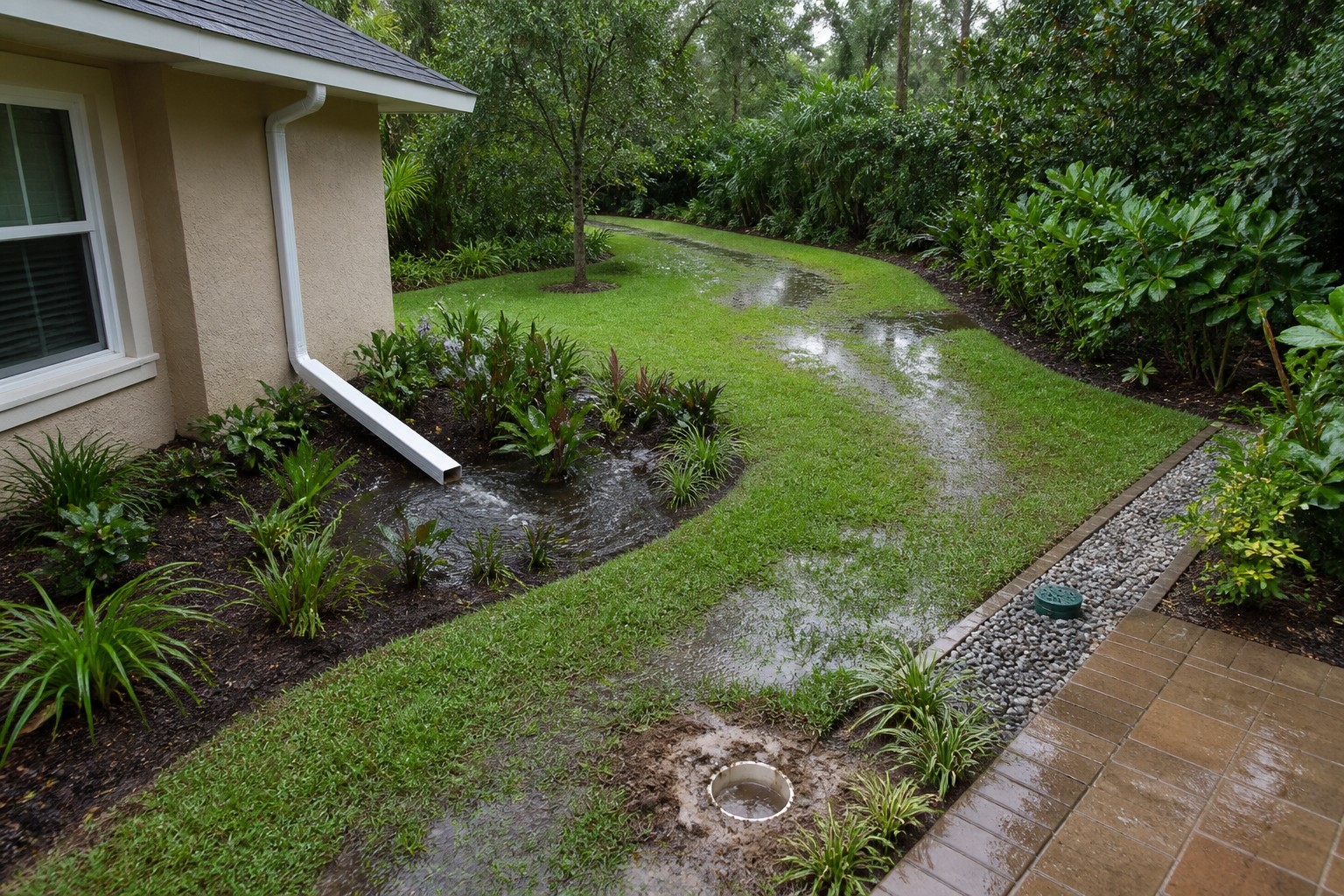
A Tampa puddle does not automatically need a French drain. The correct tool depends on where water starts, whether it moves across the surface or through soil, how fast the receiving ground drains, where overflow can go, and whether the work touches a structure, right-of-way, approved site plan, wetland, or public storm system.
Bank one storm before drawing the repair
Photograph the property before rain, during a safe rain period, immediately afterward, and at timed intervals as water recedes. Mark roof discharge, pavement runoff, irrigation, neighboring inflow, low spots, storm inlets, ditches, and the foundation edge. Note which water is on the surface and where the soil remains wet after surface water leaves.
Measure the drainage area feeding each low point. A downspout serving one roof plane is different from a yard receiving street or neighboring runoff. If water enters from public infrastructure, the City of Tampa provides a flooding-report service; a private landscape device should not be designed to accept an unknown public-flow problem.
Match the device to the job it can prove
| Device | Primary job | Evidence required before design | Failure that exposes a bad match |
|---|---|---|---|
| Grassed or planted swale | Move and spread surface water through a shallow visible corridor | Surveyed high and low points, continuous positive grade, stable surface, and safe receiving area | Reverse grade, standing pockets, erosion, or discharge that shifts water to another property |
| Rain garden | Temporarily hold and infiltrate a calculated volume of suitable runoff | Source area, soil infiltration, seasonal high-water constraints, structure and utility setbacks, overflow route, and wet/dry plant zones | Existing water already stands for long periods or the garden has no overflow during a larger event |
| French-style subsurface drain | Intercept a narrow wet line and carry collected water through gravel and perforated pipe | Source depth, trench grade, soil particle behavior, pipe and aggregate design, cleanout access, outlet, utilities, and permitting | A pipe is laid level, has nowhere lawful to discharge, clogs with sediment, or attempts to solve broad surface grading |
| Solid downspout conveyance | Carry concentrated roof water across a vulnerable area before release | Roof area, pipe capacity, joints, slope, cleanout, termination, erosion protection, and overflow | Perforated pipe leaks next to the foundation or the outlet erodes a new low point |
A swale is a grade, not a ditch-shaped decoration
A swale works because each cross-section and the longitudinal profile move water without trapping it. It should be broad enough to maintain, stable against the expected flow, and shaped so mowing or planting does not destroy the grade. The outlet must be part of the design.
Before excavation, obtain elevations at the source, along the route, and at the receiving point. A visually lower area can still contain a reverse grade. Preserve approved drainage features shown on site plans; City residential inspections reference swales, retention areas, downspouts, and grading as approved components that must be complete at final inspection.
A rain garden must drain between storms
UF/IFAS describes rain gardens as retention zones that reduce erosion and runoff and can filter surface-water pollutants. The plants must tolerate both inundation and dry periods. A rain garden uses an existing drainage relationship, but it should carry water away from structures rather than create a permanent wet basin beside them.
Test infiltration at the proposed bottom elevation, not only at today’s surface. A location where water already stands for long periods may indicate the wrong soil or a high limiting condition; excavation alone can deepen the problem. Define an overflow route for storms larger than the design event, and keep sediment from construction or eroding beds from filling the basin.
UF/IFAS Hillsborough County emphasizes Florida-Friendly practices that reduce runoff and match plants to sunlight, soil moisture, and pH. Divide the garden into bottom, side, and upper transition zones. Do not use one plant list across all three moisture bands.
A French drain is only as useful as its outlet
A French-style drain commonly uses a gravel-filled trench and perforated pipe to admit water along its length. It can intercept a narrow seep or persistently wet edge. It is not a storage solution by itself, and a perforated line installed against the foundation can collect and release water in the wrong place if the route and outlet are not engineered.
Require a section and profile: trench depth and width, pipe material and perforation orientation, aggregate, separation fabric selected for the actual soil, grade, cleanouts, inspection points, and termination. In sandy material, particle migration and sediment control deserve explicit design. An invisible trench without accessible cleanouts is difficult to verify after burial.
Never invent a discharge connection
City of Tampa Stormwater Services says it is illegal to connect an unauthorized pipe, ditch, or other structure to the storm system, and prohibits anything other than stormwater from entering drainage openings. Work in the public right-of-way is also subject to City oversight and permitting.
Before design, identify whether the outlet stays on private property, reaches an approved private system, crosses an easement, or would interact with a public inlet or ditch. Confirm authorization with the applicable agency and approved plans. Do not core a curb, open a pipe toward a street, or redirect flow across a property line because it is physically convenient.
Keep irrigation out of the diagnosis
Turn irrigation off during the rain observation period and verify the controller after power outages. A broken head or repeated schedule can create a wet area that resembles a drainage failure. The Tampa irrigation page can define a separate distribution test.
After drainage work, repeat the irrigation audit because grade changes, excavation, and planting can move heads or alter coverage. A rain garden may need temporary establishment water, but it should not become a permanently saturated irrigation zone.
Plant and mulch choices protect the hydraulic shape
Dense roots can stabilize a swale or rain-garden surface, while bare soil and floating mulch can send sediment and debris downstream. Select plants for the exact moisture band and maintenance access. Keep coarse material out of the flow throat and preserve the designed storage depth.
The Tampa Florida-Friendly comparison helps with plant and water-use context. The drainage design still controls elevation, overflow, and receiving-point evidence.
Use rainfall readback as the acceptance test
- Photograph elevations, routes, structures, utilities, and the existing ponding boundary before work.
- Record materials and as-built measurements before a trench is covered.
- Confirm cleanouts, overflow, erosion protection, and the lawful outlet.
- Observe a small rain for leaks, reverse flow, sediment, and plant disturbance.
- Observe a meaningful storm and record peak ponding plus time to drain.
- Reinspect after debris season and before the next major storm period.
If water from a public street enters a home or yard, use the City’s Tampa permit and agency guide to locate the correct review path and report the flooding issue. A private quote does not replace public-infrastructure investigation.
Tampa drainage questions
Is a rain garden suitable for any wet spot?
No. It needs suitable infiltration, separation from structures and utilities, a calculated drainage area, plants for wet and dry cycles, and a safe overflow route. A permanently saturated spot may be disqualified.
Can a swale be perfectly flat?
No. A conveyance swale needs a continuous designed grade toward a safe receiving point. Survey the profile rather than judging it by eye.
Does a French drain work without an outlet?
It may provide limited storage in the trench, but it cannot reliably convey collected water without a designed destination. Outlet legality, capacity, grade, and maintenance are core design questions.
Can I connect a yard drain to a Tampa storm inlet?
Not without authorization. The City prohibits unauthorized pipes, ditches, or structures connected to the storm system. Confirm the specific parcel, easement, right-of-way, and agency requirements first.
Sources and engineering boundary
- UF/IFAS: Saving and Using Rainwater — rain-garden purpose, placement, structure protection, resilient plants, and local-rule checks.
- UF/IFAS Hillsborough County: Landscape and Stormwater Best Management Practices — runoff, stormwater, soil, water quality, and professional-practice context.
- City of Tampa Stormwater Services — public system, unauthorized connections, discharge restrictions, and reporting.
- This comparison does not size a system. Elevations, contributing area, infiltration, high water, utilities, structures, outlet, permits, and overflow must be verified for the property.