Property-condition check: How does Irrigation installation work in Tampa?
Tampa irrigation work maps sandy infiltration, St. Augustine watering needs, controller settings, stormwater flow, and the site’s backflow conditions. Typical pricing: $2,500-$8,000 install / $125+ repair. Free written estimates. Call (813) 859-6506 for quotes throughout Hillsborough County.
Irrigation in Tampa right now is about running less water, better. Tampa and Hillsborough County are under a one-day-a-week watering schedule, and a system that is aimed wrong or timed wrong wastes the one day you get. Call (813) 859-6506 or request a free quote and we’ll look at how your system runs.
This page covers how the current Tampa watering rules work, how to set a controller around them, what sandy soil and summer storms do to a schedule, the checks that find a failing zone, how drip fits beds, and how to judge a proposal for irrigation work. It’s written for Hillsborough County’s sand and its rainy season, not for a lawn in another climate.
What are the irrigation rules in Tampa right now?
As of October 6, 2026, Tampa and Hillsborough County are under a Southwest Florida Water Management District Modified Phase III water shortage, extended through March 31, 2027. Lawns get one assigned watering day per week, only between 12:01 and 4 a.m. or 8 and 11:59 p.m.
Your day depends on the last digit of your address. Addresses ending in 0 or 1 water Monday, 2 or 3 Tuesday, 4 or 5 Wednesday, 6 or 7 Thursday, and 8, 9 or no address Friday. Properties under one acre use one window on that day. Our Tampa watering restrictions guide keeps the table, the sources and the last check date, and the watering rules data page logs each change.
There’s a detail that trips people up. For City of Tampa water customers, once a week is not a drought measure. The City has enforced once-weekly watering year-round since 1992 under its own code, so that day count stays even after the District order lifts. Outside the city limits, in unincorporated Hillsborough County, Temple Terrace and Plant City, check your own utility. Hillsborough County publishes an address lookup called Find My Watering Days and Times.
| Method | Allowed day | Allowed hours |
|---|---|---|
| In-ground and hose-end sprinklers | One assigned day per week | 12:01 to 4 a.m. or 8 p.m. to 11:59 p.m. |
| Micro-irrigation, soaker hose, hand watering | Any day | Before 8 a.m. or after 6 p.m. |
| Daytime irrigation | Not allowed | 4 a.m. to 8 p.m. |
Rules like these get extended, changed or lifted, so confirm the current phase at the District’s Water Matters site or the City’s page before you lock in a timer. Since mid-April 2026, local utilities can issue citations without a prior warning.
How should I set my controller for one day a week?
Water deeply on your assigned day, inside the allowed window, and let rain do the rest. Aim for about half to three quarters of an inch per application on turf, split into two or three short cycles so the water soaks in instead of running off.
Sandy soil drains fast, so a single long run sends water past the roots. Cycle and soak keeps more of the same minutes in the root zone: run each zone for a short period, pause, then run it again. Our Tampa soil guide explains why sand holds so little water and nutrients, and why timing matters more than volume.
- Pick one window per day. Properties under an acre use one window, either pre-dawn or late evening. Either is allowed, so choose the one your pressure and controller handle best.
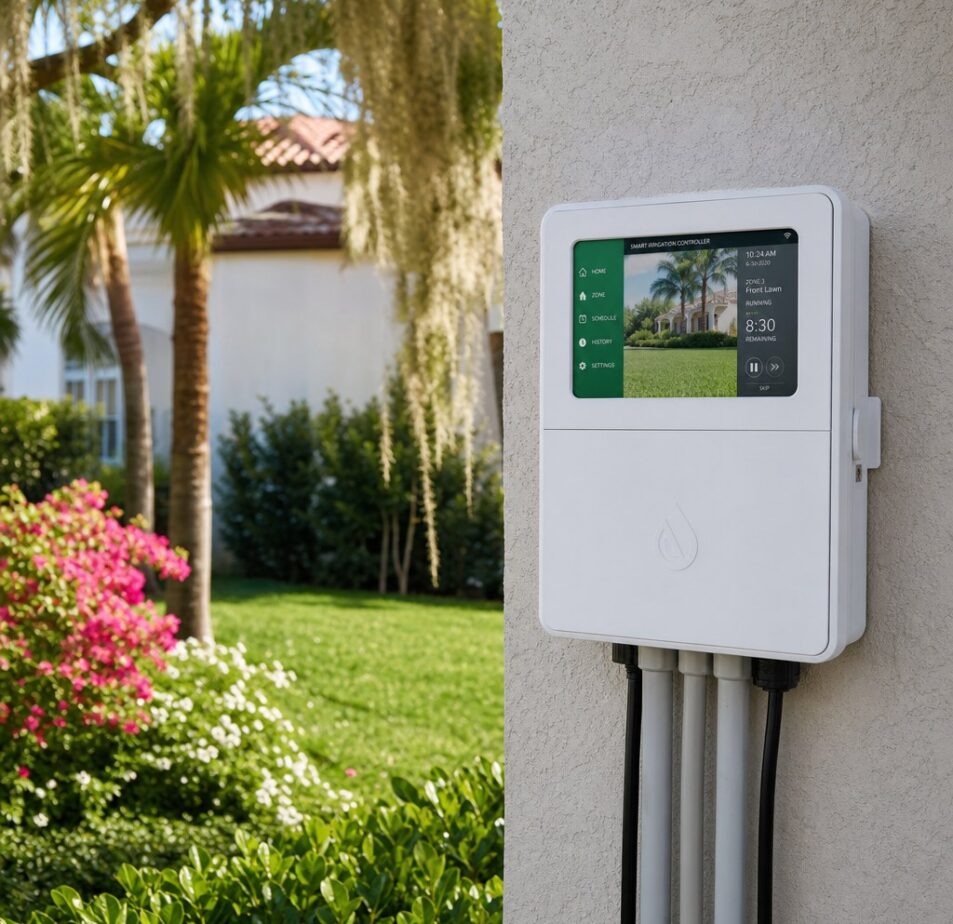
- Set seasonal adjustment. Rain and heat swing hard in Tampa. A smart controller that pulls local weather helps, but check its settings against the assigned day, because a controller that thinks it’s allowed Tuesdays is a citation waiting to happen.
- Keep the rain sensor working. Florida requires one on automatic systems. It’s what stops a July thunderstorm becoming a violation by timer the next morning.
- Write it down. A one-page schedule taped inside the controller box saves a lot of guessing.
Is drip irrigation allowed on other days?
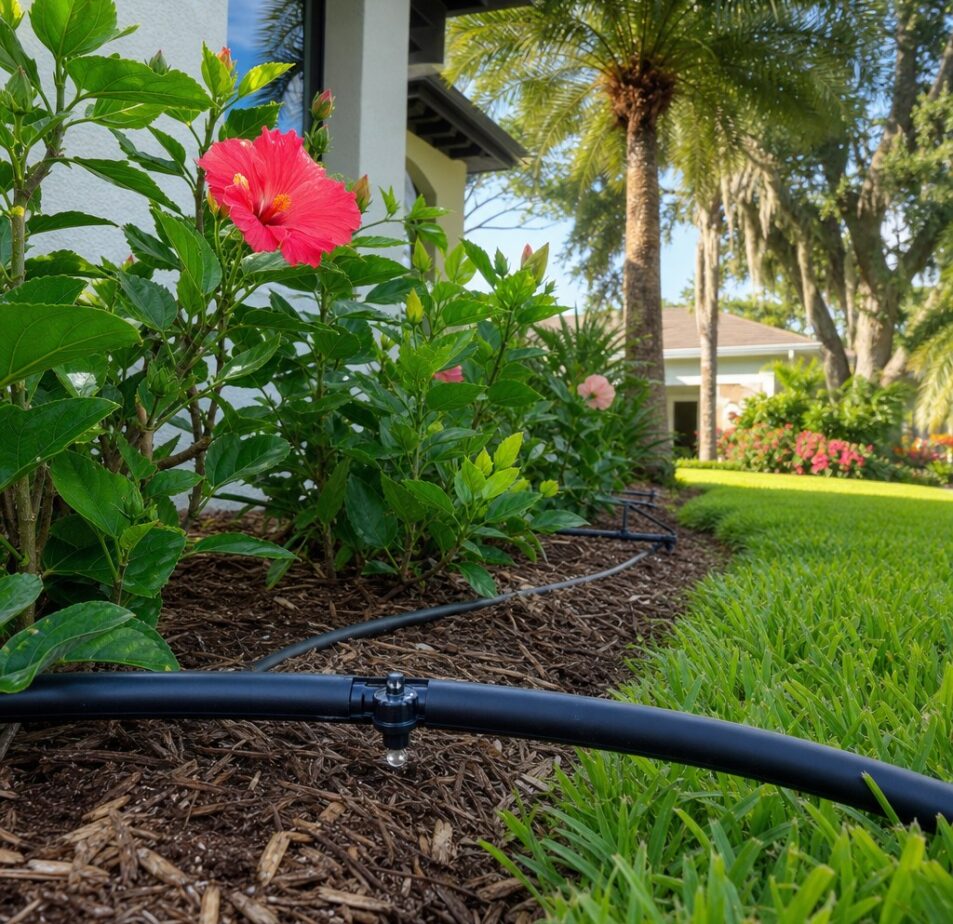
Yes. Under the current order, micro-irrigation, soaker hoses and hand watering are allowed any day, but only before 8 a.m. or after 6 p.m. That makes drip and micro-spray the most restriction friendly way to water beds, new plantings and containers.
Drip puts water at the roots rather than spraying across the air, which is why the rule treats it more gently than sprinklers. On a mixed landscape that’s the practical answer: turf on the one assigned day, beds on drip the rest of the week. Our Florida-Friendly versus traditional comparison explains how grouping plants by water need makes that split work.
What is the rule for watering new sod and new plants?
New lawns and plants get a 60 day establishment period. During days 1 to 30 you may water any day within the City’s permitted hours. During days 31 to 60, even addresses may water Tuesday, Thursday and Sunday and odd addresses Monday, Wednesday and Saturday.
Two conditions come with it. Keep a written schedule of the establishment watering, and remember the allowance doesn’t open the prohibited hours. Daytime sprinkling between 4 a.m. and 8 p.m. is still off limits. Low volume and hand watering remain available on top of that. If you’re laying sod this fall, plan the install and the schedule together, and see our lawn mowing page for what the first cuts look like.
Why does a Tampa irrigation schedule fail on sandy soil?
Sand holds very little water. UF/IFAS research cited in our soil guide reports that almost all of the moisture and nutrient holding capacity of Florida’s sandy soils depends on the less than 2 percent that is organic matter. Water drains past the roots fast, so a lawn can look dry in days.
That’s why more water isn’t the answer on a one-day schedule. Delivering the water evenly is. Common reasons a zone browns even though the timer ran: heads tilted by mower strikes or settling sand, nozzles clogged with debris, a cracked line leaking below the surface, and heads that sprayed fine in March but are now blocked by grown-in shrubs. A hot, dry stretch is unforgiving, and St. Augustine under water stress is exactly what chinch bugs look for.
Our summer lawn care guide walks through the season: water deep on the assigned day, mow St. Augustine at 3.5 to 4 inches to shade the roots, and hold heavy fertilizer until the lawn can drink.
What does an irrigation check look like, step by step?
A proper check runs every zone, looks at every head and ends with a written schedule you can read. It’s meant to find waste and failures before the hot stretch, and to match the controller to the assigned day. You see what was found and decide what gets fixed.
- Confirm the rules for your address (a few minutes). Your assigned day and window are checked against the City or County lookup. You tell us how the lawn and beds have been behaving.
- Look at the controller and sensor (about a quarter hour). Run times, start times, seasonal adjustment and the rain sensor are checked. You decide whether to keep or change the program.
- Run each zone and watch it (the main part of the visit). Heads are checked for coverage, alignment, blockage and leaks, one zone at a time. Wet spots and dry spots are noted on a sketch.
- Review what was found with you. You get a plain list: what’s working, what’s failing, and what each fix involves. You decide what to repair now and what can wait.
- Adjust and set the schedule (same visit where possible). Minor head adjustments are made, times are reset for deep, split cycles, and the schedule is written out for the controller box.
- Follow up after the next rain. You watch for runoff, ponding and dry patches, and report back so settings can be adjusted again.
Repairs or changes beyond a simple adjustment are quoted after the check, with the parts and labor written down. We’d rather you approve a short list than get a bill for work you didn’t see needed.

How do I know my irrigation system needs repair?
Look for brown or lush patches that don’t match the rest of the lawn, water running onto the pavement, heads that don’t pop up or won’t shut off, and a water bill that jumps without a reason. Any of those justifies a check before the next assigned day.
- Persistent soggy spots: often a broken head or a cracked line below the surface.
- A zone that never comes on: a stuck valve, a solenoid problem, or a wiring fault.
- One zone with weak spray: low pressure from a clogged filter, a partial break or a valve issue.
- The timer ran but nothing wet: a controller set for the wrong day or a sensor that stayed locked off.
- Water running at night in a storm: a rain sensor that isn’t doing its job.
The point of a diagnostic walk is to avoid guessing. A zone that browns can have three different causes, and the right fix for one wastes money on the other two.
Do irrigation systems need a permit or backflow testing in Tampa?
Yes, on both counts. The City of Tampa lists new irrigation and reclaimed water systems among residential projects that require a permit, and properties with in-ground irrigation must have an approved backflow preventer, tested every two years by a certified technician.
Our Tampa landscaping permit guide covers the details. Residential backflow devices must be tested every two years, results go to the City within seven calendar days of the test, and a failed device must be repaired or replaced within fifteen days. If you’re not sure of your device’s testing status, ask the Tampa Water Department’s cross connection program, because a lapsed test is a compliance problem that has nothing to do with how well the sprinklers spray.
How does irrigation interact with fertilizer and mowing rules?
They share the same calendar. From June 1 through September 30, Hillsborough County bans fertilizer containing nitrogen or phosphorus, and watering is restricted to the assigned day. Mowing height also matters, because taller turf shades soil and needs less water. Plan all three together.
Fertilizer that leaches past the root zone in sandy soil ends up in the bay, which is why the summer ban exists. Our Tampa fertilizer rules page lists the dates and what is allowed in the off season. Watering heavily after applying a product is an easy way to send it through the sand, so time the two together.
Where does drainage fit into an irrigation plan?
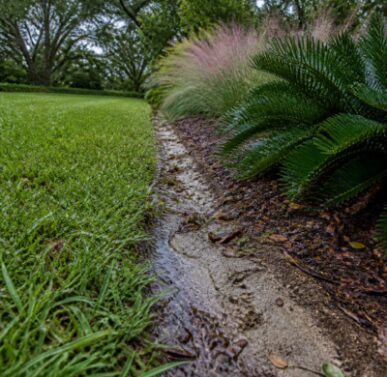
Before irrigation, you have to know where water goes when it rains. Tampa’s downpours can drop several inches in an afternoon, and a low spot that holds water will drown turf no matter what the controller says. Fix the water path first, then tune the schedule.
Roof discharge, pavement runoff, neighboring inflow and low spots all feed the same yard. Photograph the property during and after a storm, then map where water enters, pools and leaves. Our rain garden, swale and French drain guide describes how to match a device to the problem, and why a private device shouldn’t be designed to accept an unknown public flow. A swale or rain garden can also pull double duty by keeping irrigation runoff out of the street.
How should an irrigation system be set up on a bay or waterfront lot?
Salt air and salt spray shorten the life of the wrong parts and burn the wrong plants. On bayside and beach lots, choose corrosion resistant components and salt tolerant plantings, and rinse salt off foliage after storms. The schedule rules are the same, but the hardware choices change.
Our summer lawn guide makes the point plainly: on waterfront lots, specify corrosion resistant components that hold up to salt air, and pick salt tolerant species such as sea grape, muhly grass, saw palmetto and viburnum where turf struggles. A salt exposed bed on spray heads is a double loss, because the spray carries salt onto leaves and the water doesn’t reach the roots. Micro-irrigation under mulch solves both, and it’s legal on any day before 8 a.m. or after 6 p.m.
After a tropical system or a heavy storm, walk the yard for low spots, standing water and erosion, and look at the valve boxes. Boxes that flooded can hide a failed solenoid or a split fitting, and a zone that fails to come on after a storm usually shows it on the next assigned day, when you can’t afford the miss.
What is the right way to handle the rainy season versus the dry season?
In the rainy season, let the rain sensor work and skip irrigation after a good soak, because overwatering drives disease. In the dry season, tail end of spring is the hardest stretch, so water deep on the assigned day, mow tall, and hold heavy fertilizer until the lawn can use it.
Daily afternoon storms often supply a lot of what a lawn needs in summer, which makes the real skill not overwatering. A soaked lawn plus Gulf Coast humidity invites fungal disease, and sandy soil drains fast enough to fool you into thinking more water is the fix. When the storms stop and heat builds before the rains arrive, a once a week schedule is at its tightest, and that is when a leaking zone or a clogged head shows up as a brown patch within days.
Check the system in spring before that stretch begins. Run each zone, fix broken heads, adjust coverage, and confirm the controller program matches the current rules. A system tuned before the hot, dry weeks costs a lot less to keep alive than one rescued after the lawn browns.
What do typical irrigation situations look like in Tampa?
These typical scenarios illustrate how problems show up and get solved. They’re examples, not records of customers, and no figures here are quotes. Your system will always be assessed on its own condition and written up before any work starts, so you can see what was found.
- A typical front yard with a browning strip: a St. Augustine lawn with a brown band along the driveway. The check finds two tilted heads spraying the pavement and a clogged nozzle. Heads are adjusted, the zone time is split into two short cycles, and the strip recovers over the next weeks.
- A typical backyard with soggy and dry patches: one zone is soaking a low corner and missing the high side. The check finds a cracked lateral and an unbalanced head layout. The repair is scoped and approved before it’s done, and the program is reset for the assigned day.
- A typical bed that burns every summer: a bed of shrubs on overhead spray that gets watered with the lawn. Moving it to micro-irrigation lets it run any day before 8 a.m. or after 6 p.m., without waiting on the lawn’s single day.
How should I compare irrigation proposals?
Ask each company to write down what they inspected, what they found, what they’ll change and what they exclude. Compare the zone by zone findings, not only the total. A bid that can’t explain which zones fail and why is a guess.
- Is the controller program written out for your assigned day and window?
- Does the proposal mention the rain sensor and its location?
- Are backflow status and testing addressed?
- Are parts, labor and any permit handled separately and clearly?
- Is there a follow-up plan after the first rain?
Our landscape design page is the right place for larger changes such as reshaping beds or moving to a lower water plant palette, since irrigation changes should follow the plan, not precede it.
Which Tampa Bay communities do we cover?
We work in Tampa and the surrounding Hillsborough County communities, including Brandon, Riverview, Lutz and Plant City. Tell us your address area in the quote request and we’ll confirm that you’re on our route before we spend time on the check.
How do I get an irrigation check or quote in Tampa?
Call (813) 859-6506 or use the free quote form. Tell us your address, whether you’re on City of Tampa water or another utility, what you’re seeing in the lawn, and what the controller is set to. A photo of the controller screen helps more than you’d expect.
We’ll respond with next steps and a written scope for anything beyond a simple adjustment. If you’re planning new sod, a bed conversion or a drainage fix this season, tell us at the start so the irrigation work fits the sequence.
Ready now? Get your free Tampa irrigation quote or call (813) 859-6506.
Which recorded conditions support a property decision on Irrigation?
Tampa crews document each route visit against the approved scope, with Gulf Coast sand, St. Augustine or Bahia turf, irrigation, stormwater, and salt exposure recorded for the property manager.
“Our Tampa crew runs Irrigation across Hillsborough County every week. Same teams, same schedule, same standard.”— Tampa Pro Landscape Operations Team
- Professionally managed local crews on dedicated weekly routes
- Serving multiple Hillsborough County suburbs on fixed route schedules
- Operator-grade scheduling and reporting
- Free written estimates on every job