
Last verified: October 6, 2026, against City of Tampa Water Department and the Southwest Florida Water Management District.
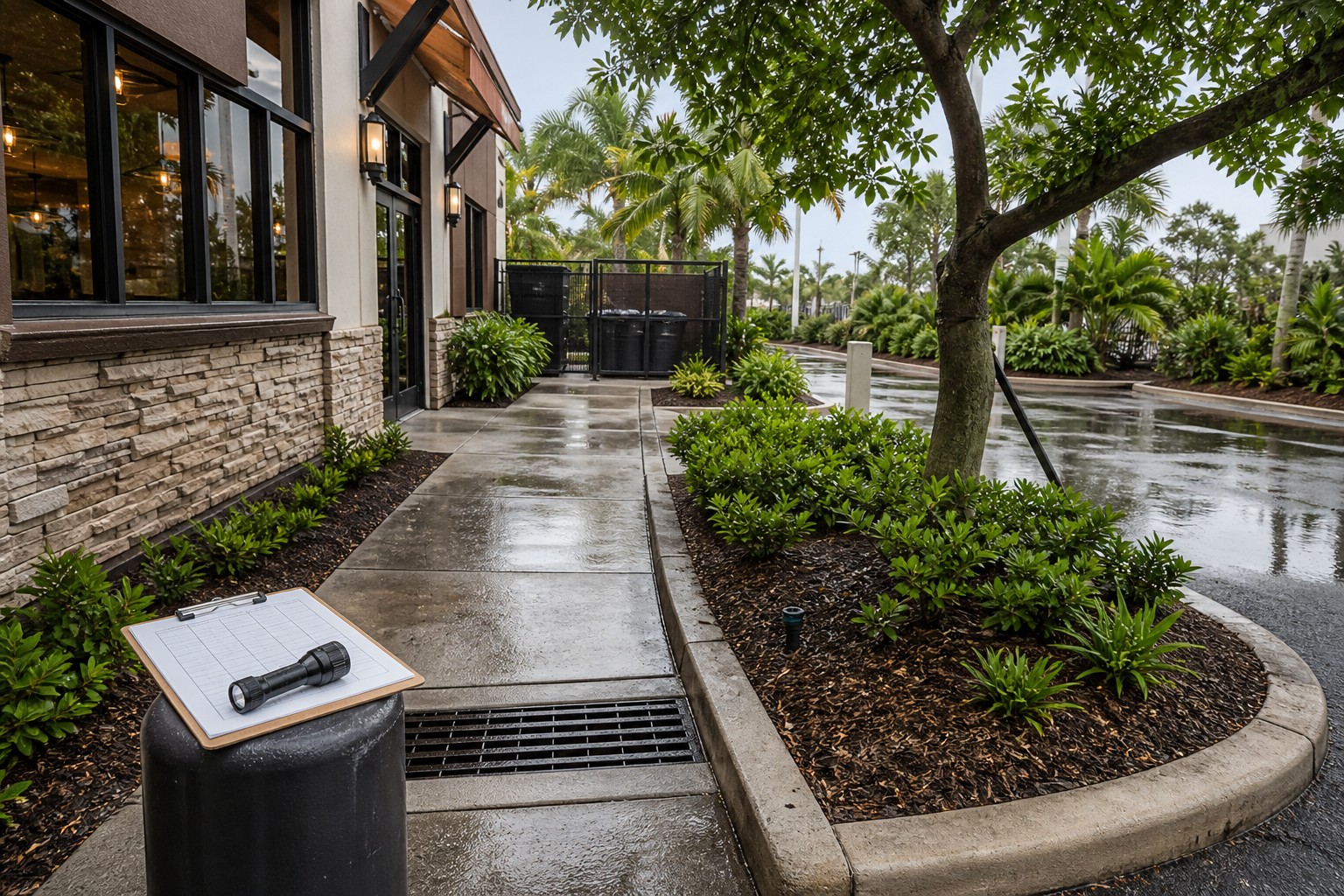
A Tampa restaurant landscape is not merely a lawn-and-bed contract. It shares space with guest access, deliveries, waste and grease handling, storm drains, lighting, signage, outdoor seating, and emergency routes. The most useful exterior inspection follows those operations and records what changed after rain, irrigation, a service visit, or a storm.
Start at the parcel boundary and name the jurisdiction
A mailing address that says Tampa does not by itself prove the site is inside the City of Tampa. Unincorporated Hillsborough County has its own watering schedule, while the cities in the county publish separate rules. The current county page explicitly directs properties in incorporated municipalities to follow their city’s restrictions.
Record the parcel jurisdiction, irrigation water source, address pattern, property type, and responsible agency before programming a controller. As of October 6, 2026, the District’s standard schedule under the one-day-per-week Modified Phase III order assigns Friday to locations with a mix of addresses or for which an address cannot be determined, such as subdivision common areas, and the District extended that order through March 31, 2027. The City of Tampa’s own schedule also assigns Friday to mixed addresses, no-address common areas, office complexes, and shopping centers. Confirm which agency serves the parcel before copying either rule onto a property.
Walk six routes instead of one landscape
| Route | What to observe | Evidence to bank | Owner for correction |
|---|---|---|---|
| Guest arrival | Clear width, low branches, sight lines, trip edges, ponding, lighting conflicts, and material on pavement | Photos from parking and sidewalk approaches at open and closed hours | Property manager, landscape scope, or pavement/lighting contractor |
| Outdoor dining perimeter | Overspray, leaf or fruit drop, insects, thorns, root uplift, and drainage toward occupied space | Irrigation run observation and after-rain photo | Manager plus applicable landscape, pest, or facilities specialist |
| Delivery path | Vehicle turns, gate clearance, branch height, broken curbs, hidden heads, and blocked doors | Marked route with delivery-window observation | Facilities lead and vendor responsible for each conflict |
| Waste and grease area | Loose litter, leaking containers, soil erosion, non-stormwater discharge, and vegetation limiting access | Closed-enclosure photo, spill record, drain relationship, and cleanup owner | Restaurant operations, waste hauler, grease service, or property management |
| Stormwater path | Roof discharge, swales, grates, curb inlets, leaves, sediment, mulch migration, and low points | Dry baseline plus active-rain or immediate post-rain sequence | Landscape maintenance only for its defined debris; drainage defects need separate review |
| Emergency and utility access | Panels, hydrants, shutoffs, fire route, meters, and equipment clearances | Site plan reference and unobstructed-condition photos | Property manager and applicable authority or trade |
The drain check happens during rain
Dry pavement does not show the source or direction of flow. During safe conditions, record where roof, parking-lot, irrigation, and bed runoff travel. Mark ponding boundaries, note how long water remains, and photograph any organic debris accumulating at grates or curb openings.
City of Tampa Stormwater Services says many drains outfall to local waters and prohibits non-stormwater materials in the system. Its business guidance directs properties not to blow soil, grass, or leaves into streets or drains, to sweep sidewalks and common areas, and to audit the site for non-stormwater discharges. Those are clear acceptance points for an exterior service scope.
The City’s March 2026 storm-season update reported expanded ditch grading and again warned residents and lawn services not to blow yard debris into storm drains. A contractor visit is incomplete if the turf is cut but clippings, leaves, soil, or mulch remain in the runoff path.
Waste enclosure landscaping needs a hard boundary
Shrubs can screen a refuse area, but they cannot block gates, prevent lid movement, conceal a leak, or narrow the collection route. Set the planted edge outside the equipment swing and vehicle path. Keep the ground visible enough to inspect for litter, erosion, and discharge.
Tampa’s commercial pollution-prevention guidance specifically addresses restaurant oil and grease storage, refuse containment, solid-waste hauling, and non-stormwater discharge. The landscape contractor should not absorb those operating responsibilities by implication. The written matrix should name who reports a leak, who contains it, who cleans pavement, and who verifies the drain stayed protected.
Irrigation must be observed at operating time
Run each zone during the legal window and observe guest walks, service doors, parking spaces, walls, and outdoor seating. Record broken heads, misting, runoff, and spray crossing pavement. A zone schedule is not proof that all devices work or that water remains on the intended landscape.
For unincorporated county properties under the current shortage order, conventional irrigation must occur in the published overnight windows and only once on the assigned day. New-landscape exceptions and chemical watering-in have separate conditions. Reverify the current county page and the site’s jurisdiction immediately before changing timers. The existing Tampa-area watering page is a routing aid, not a substitute for the issuer.
Fertilizer and treatment records must identify the applicator boundary
A maintenance visit may include mowing and debris removal without authorizing pesticide or fertilizer work. The scope should state whether treatments are excluded, separately approved, or assigned to another qualified provider. Record product, applicator, date, area, weather, watering-in instruction, and sign or notice where required.
Use the Tampa fertilizer-rule page to locate the relevant issuer information. Do not merge City and county claims. Restaurant operations should also know who prevents granules, soil, or wash water from reaching pavement and storm drains.
Storm preparation is a sequence, not an emergency promise
Before the seasonal risk period, photograph drains, ditches, tree defects visible from the ground, loose landscape material, vulnerable pots, access routes, and vendor responsibilities. Define what can be corrected through routine maintenance and what needs a qualified tree, drainage, electrical, roofing, or structural contractor.
Do not promise storm outcome, response time, or hazardous tree work unless a named provider accepts it in writing. The landscape plan can reduce loose debris and preserve access. It cannot certify that a property will not flood or that a tree will withstand wind.
After a warning, prioritize safe removal or securing of movable items and collection of already generated debris without blocking inlets. After the event, restrict access to hazards, photograph before cleanup, and assign each defect. The Tampa cleanup page can support routine debris scope, while hazardous and regulated work stays separate.
A restaurant bid needs operational line items
- Areas: guest frontage, dining perimeter, parking islands, service route, waste enclosure, drainage path, and excluded zones.
- Timing: approved access window, noise constraints, delivery conflicts, irrigation window, and event exceptions.
- Results: clear pavement, defined sight lines, drain-free debris, contained irrigation, measured pruning boundary, and documented disposal.
- Evidence: visit date, before-and-after exceptions, irrigation defects, stormwater observations, and change approvals.
- Escalation: who receives a leak, ponding, blocked drain, suspected tree hazard, pest observation, or treatment request.
The general Tampa commercial-landscape page covers procurement context. This checklist adds the restaurant-specific operating routes and acceptance evidence that should be attached to a bid.
Restaurant grounds questions
Do all Tampa-area restaurants water on Friday?
No. The current Friday rule cited here applies to certain common, no-address, and mixed-address properties in unincorporated Hillsborough County. Incorporated City properties follow their city’s current rule. Verify jurisdiction first.
Can landscape debris be blown into a curb inlet?
No. City stormwater guidance says not to blow soil, grass, or leaves into streets or drains. Sweep and collect the material as part of service acceptance.
Who handles a grease leak near landscaping?
The written responsibility matrix should identify restaurant operations, the waste or grease vendor, and property management. A landscape crew may report and protect the area within its safety rules, but responsibility should not be assumed.
Does this checklist certify storm safety?
No. It documents visible conditions, access, debris, irrigation, and drainage observations. Hazardous tree, structural, electrical, flood, and emergency decisions require the appropriate qualified parties.
Sources and jurisdiction limits
- City of Tampa: Pollution Prevention Tips — residential and business stormwater practices, restaurant waste context, sweeping, and non-stormwater audits.
- City of Tampa: Clearing Ditches Ahead of Storm Season — 2026 operations and yard-debris warning.
- Hillsborough County: Find My Watering Days and Times — current unincorporated-county shortage rules and jurisdiction warning.
- Reverify every watering claim at the issuer immediately before programming because the current shortage order can be changed, reduced, or extended.